
We generated the largest single-cell datasets of inflammatory bowel disease relevant samples, spanning millions of cells across the ileum, blood and rectum, from hundreds of individuals with and without inflammatory bowel disease. We were able to perform well-powered analyses comparing the effects of disease, location and genetics on cellular expression.

Comprehensive profiling of terminal ileum cell types, highlighting cell types present in the termninal ileum, key differences between inflamed and uninflamed bowels and which cell types are enriched for dysruptive genetic variants.
Krzak, Alegbe, Taylor, Jones et al.
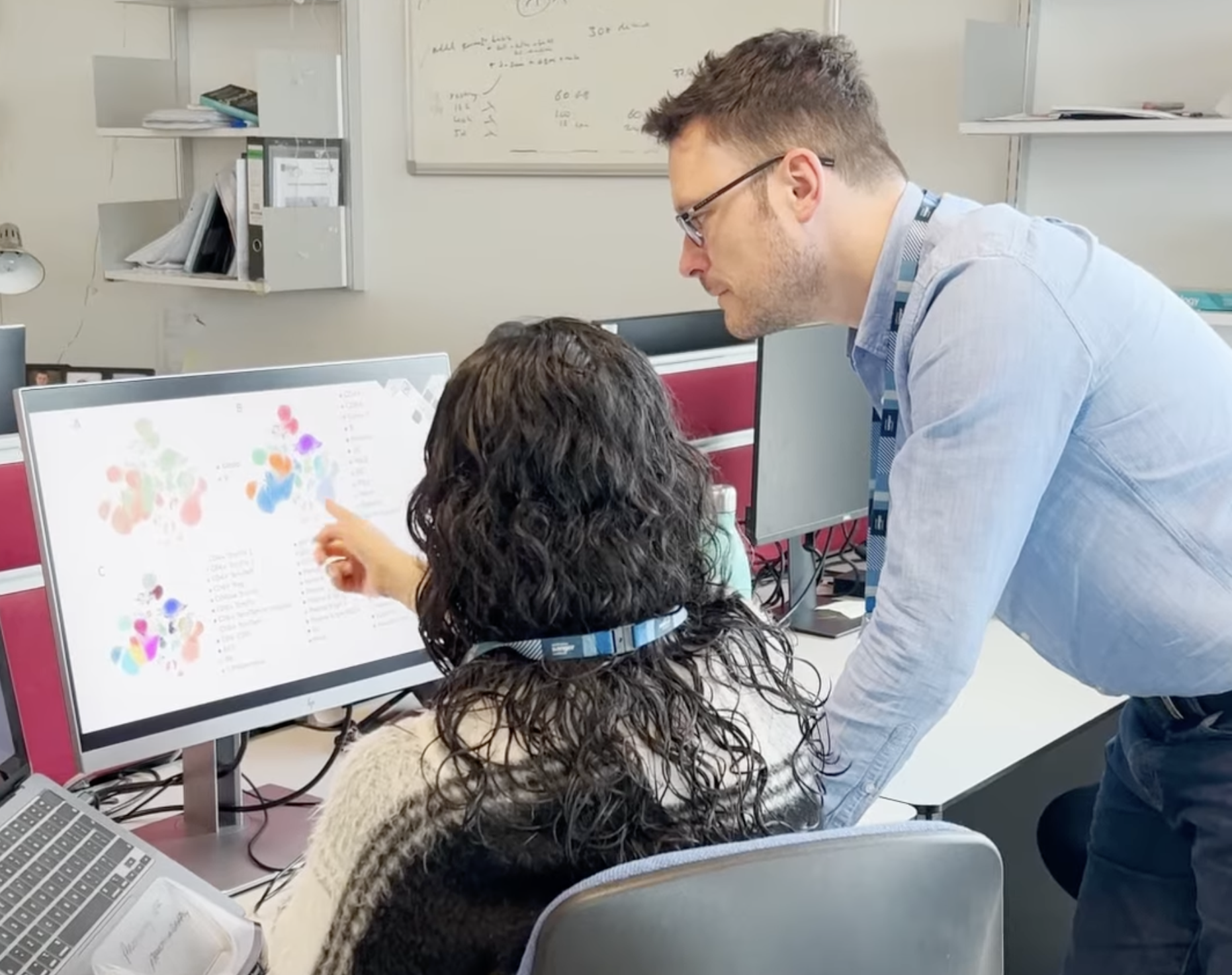
Identification and quantification of the differences in immune cells between blood and gut samples from individuals with Crohn's disease. Several populations and processes are seen to be enriched in either tissue and blood.
Ramirez-Navarro et al.

Identification of eQTLs within single-cell resolved cell types from ileum, rectum and blood. Integrating these eQTLs with exist disease risk GWAS offers insight into the genes and cell types causally driving inflammatory bowel disease.
Alegbe, Harris et al.
![[interface] image of educational software interface (edtech) standalone](https://cdn.prod.website-files.com/686591568ad497e5cefc9674/68e796158c82d3a420e865d2_ef9a22b8d0a96c614c8d4e75603d3d9b_download_data.png)
Building on the foundations that this work has laid down we intend to take further steps to use single-cell RNA-sequencing approaches to better understand IBD biology. These include:
IBDresponse
OpenIBD
Long-read sequencing IBDverse
Get straightforward answers about our datasets, publications, and findings. Designed for those who have or know someone who has an inflammatory bowel disease such as Crohn's disease or ulcerative colitis.
Whilst the results of our study are promising we emphasise caution in their interpretation.
Any proposed novel therapeutic targets can take many years of validation and trials before they can reach the clinic but our research is one step closer to that goal.
We have released three manuscripts detailing our findings for the wider scientific and medical community to read. These manuscripts are not written with the public in mind and can contain highly technical terminology so we have also written a short summary of these findings which can be found here.
All patient information is confidential so before sharing any data, we carefully removed any information that could identify individual participants.
However we want to make sure that the information collected and generated as part of this project can be used by other researchers to increase our understanding of inflammatory bowel disease and improve the treatment of people living with it. To support this goal, we have made these data available for others to use. Some data will be freely available to download directly from this website. More detailed datasets, including the clinical information gathered during this project, will be require review by a data access committee to ensure that the data are used responsibly.
The project was funded by:
Yes. A contact email address for the authors of these studies is provided at the bottom of this page. Please note that these questions should only be related to this work rather than IBD in general.
We are primarily research scientists and cannot offer medical advice into the treatment of IBD. You should contact your doctor if you have issues with your disease.
Here we present the IBDverse data from each of our three papers in both an interactive and downloadable format, allowing IBD researchers the opportunity to conduct their own focused analyses.
![[background image]](https://cdn.prod.website-files.com/686591568ad497e5cefc9674/68cd101c6a278a10d6523f16_labwork.jpg)
![[team] image of pharmacy technician reviewing prescriptions](https://cdn.prod.website-files.com/686591568ad497e5cefc9674/689069b08084c574b6d587bb_IMG_2204.jpg)
![[interface] ai healthcare research interface on a laptop screen](https://cdn.prod.website-files.com/686591568ad497e5cefc9674/68cd0dc06f75274a8e2cf72d_cristina_jasmin.jpg)
![[headshot] image of customer (for a maritime service)](https://cdn.prod.website-files.com/686591568ad497e5cefc9674/6865d60bb66520398c655450_carl.jpg)
![[headshot] image of customer (for a gym)](https://cdn.prod.website-files.com/686591568ad497e5cefc9674/6874d000eb977a32f16d711f_Tim-Raine.png)
![[headshot] image of satisfied customer (for a nonprofit & charity)](https://cdn.prod.website-files.com/686591568ad497e5cefc9674/6874d08dbba8d2f8c733cb14_bh18.jpg)
![[headshot] image of customer (for an accountant & cpa firm)](https://cdn.prod.website-files.com/686591568ad497e5cefc9674/690dde5dc1855f7d48c523f7_25b3bb6c8d53bf2bc8448cd87264de3a_cristina.png)
![[headshot] image of customer (for a coffee shop & cafe)](https://cdn.prod.website-files.com/686591568ad497e5cefc9674/6874d0bc4db1af7301973edc_gareth.jpg)
![[headshot] image of a customer (for a personal coach & consultant)](https://cdn.prod.website-files.com/686591568ad497e5cefc9674/6909a8da45f7117e463263cd_anderson_lab_avatar.png)
![[headshot] image of customer (for a chinese restaurant)](https://cdn.prod.website-files.com/686591568ad497e5cefc9674/6874d09a7695e3a04c390350_lr23.jpg)
![<subject>[headshot] image of a customer (for a mobility and transportation)</subject>](https://cdn.prod.website-files.com/686591568ad497e5cefc9674/6874d0b1951d4f62603b26e9_monika_krzak_.png)
![[headshot] image of customer (for an accountant & cpa firm)](https://cdn.prod.website-files.com/686591568ad497e5cefc9674/690dde622f65d7f164499c72_fd67d44a77e62c5e9c28638dc5073f92_Rebecca%20McIntyre_005.jpg)
![[headshot] image of customer (for an accountant & cpa firm)](https://cdn.prod.website-files.com/686591568ad497e5cefc9674/6874d03d28c4f85271af2b34_3b39fc8d5560bdc91dfd11fce3b285c8_tobi.jpg)